




Understanding Towball Weight, GVM, GCM, Tare & ATM
If you’ve spent any time researching caravans or towing setups, you’ve probably come across terms like towball weight, GVM, GCM, Tare and ATM. While these abbreviations can seem overwhelming at first, understanding them is one of the most important steps toward safe and legal towing.
Many towing issues occur not because a vehicle lacks power, but because weight limits have been exceeded without the driver’s knowledge. By understanding the basic weight ratings that apply to your vehicle and caravan, you’ll be better equipped to load correctly, tow safely, and travel with confidence.
Why Caravan Weight Ratings Matter
Every vehicle and caravan is designed to operate within specific weight limits. These limits exist to ensure the vehicle can accelerate, brake, steer, and handle safely under a wide range of conditions.
Exceeding weight limits can negatively affect stability, braking performance, tyre wear, fuel consumption, and overall handling. In some situations, it can also place additional stress on vehicle and caravan components, leading to premature wear and maintenance issues.
The good news is that once you understand a few key terms, caravan weights become much easier to manage.
What Is Tare Weight?
Tare weight is the weight of the caravan as it leaves the factory before personal belongings, water, food, clothing, accessories, and other travel items are added.
Think of Tare as the caravan’s empty starting weight. While it provides a useful reference point, very few caravans travel at their Tare weight in the real world.
As soon as you add camping gear, batteries, water, tools, luggage, or optional accessories, the caravan’s actual weight begins to increase.
Because of this, caravan owners should view Tare as the baseline rather than the weight they will actually be towing.
What Is ATM?
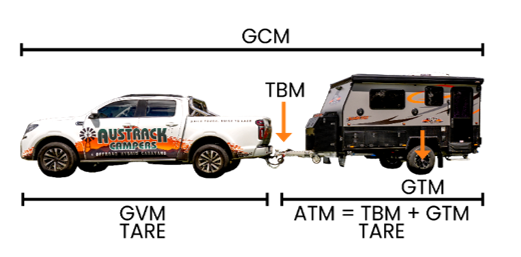
ATM stands for Aggregate Trailer Mass. This is the maximum permissible weight of the caravan when it is fully loaded and disconnected from the tow vehicle.
ATM includes everything inside and attached to the caravan, including water, batteries, food, clothing, camping equipment, gas bottles, personal belongings, and accessories added after purchase.
The ATM is one of the most important numbers caravan owners should understand because it represents the maximum legal weight of the caravan.
This figure can usually be found on the caravan’s compliance plate.
What Is Towball Weight?
Towball weight is the amount of downward force the caravan applies to the vehicle’s towball when connected.
This weight forms part of the vehicle’s load and directly affects towing stability. A caravan with insufficient towball weight may be more susceptible to sway, while excessive towball weight can overload the rear axle of the tow vehicle and affect handling.
Towball weight is not additional weight that exists separately from the caravan’s ATM. Instead, it represents how the caravan’s loaded weight is distributed between the caravan wheels and the tow vehicle.
Understanding towball weight is essential because both the caravan and tow vehicle have maximum allowable limits that must be respected.
What Is GVM?
GVM stands for Gross Vehicle Mass. This refers to the maximum permissible weight of the tow vehicle itself.
GVM includes the vehicle, fuel, passengers, accessories, cargo, and the towball download weight from the caravan.
Many people focus solely on their caravan’s weight while overlooking their vehicle’s GVM. However, even if your caravan is within its legal limits, the tow vehicle can still exceed its own GVM if too much weight has been loaded into the vehicle.
This is particularly common among travellers carrying additional fuel, recovery gear, toolboxes, canopies, roof racks, camping equipment, and other touring accessories.
What Is GCM?
GCM stands for Gross Combination Mass. This is the maximum allowable weight of the tow vehicle and caravan combined.
In simple terms, GCM is the total combined mass of the entire towing combination as it travels down the road.
Even if your caravan is within its ATM and your vehicle is within its GVM, you still need to ensure the combination does not exceed the manufacturer’s GCM limit.
For larger caravans and heavily equipped touring vehicles, GCM often becomes the limiting factor.
Where Can You Find These Ratings?
Most caravan weight ratings can be found on the caravan’s compliance plate, which is typically located near the entry door or on the drawbar.
Vehicle weight ratings can usually be found in the owner’s manual, on the vehicle compliance plate, or within the manufacturer’s published specifications.
Knowing where to find these figures is the first step toward understanding your towing setup.
Don’t Guess Your Weights
One of the most common mistakes caravan owners make is assuming they are within weight limits rather than verifying them.
Accessories, full water tanks, additional batteries, solar upgrades, toolboxes, generators, recovery gear, and everyday travel items can add substantial weight surprisingly quickly. What starts as a few small additions can easily accumulate into several hundred kilograms over time.
Many owners visit a public weighbridge and assume the resulting figure tells the whole story. While a weighbridge may provide a useful reference point, it often only provides a total weight and does not always reveal how that weight is distributed throughout the vehicle and caravan combination.
Understanding your setup requires more than just a single number.
Have Your Setup Professionally Weighed
One of the best investments any caravan owner can make is arranging for their vehicle and caravan to be weighed by a professional caravan weighing service.
Mobile weighing specialists are able to assess much more than the total combined weight of your setup. They can measure individual axle weights, towball weight, vehicle weight, caravan weight, and determine how those figures relate to your vehicle’s GVM, caravan ATM, and overall GCM limits.
This level of detail is incredibly valuable because a setup can sometimes appear compliant when looking at total weights alone, while still exceeding an axle limit or carrying an unsuitable towball weight. These issues can have a significant impact on safety, handling, tyre wear, and towing performance.
Professional weighing services can also provide education on load distribution and help owners better understand how different items affect the overall balance of their setup. Whether you’ve recently purchased a caravan, fitted additional accessories, upgraded batteries, or are preparing for a major trip, having your van professionally weighed removes the guesswork and provides valuable peace of mind.
Understanding Your Numbers Builds Confidence
You don’t need to become a weight compliance expert overnight, but every caravan owner should understand the basic terms that apply to their setup.
Knowing what Tare, ATM, towball weight, GVM and GCM mean allows you to make better loading decisions, identify potential issues, and tow with greater confidence. More importantly, it helps ensure your vehicle and caravan are operating as intended, making every journey safer and more enjoyable.
Final Thoughts
Towball weight, GVM, GCM, Tare and ATM may initially seem confusing, but they are simply different ways of measuring how weight is distributed throughout your towing setup.
Taking the time to understand these ratings, locate them on your vehicle and caravan, and have your setup professionally weighed can significantly improve both safety and confidence on the road. Whether you’re planning a weekend getaway or a lap around Australia, understanding your weight ratings is one of the most valuable skills any caravan owner can develop.